
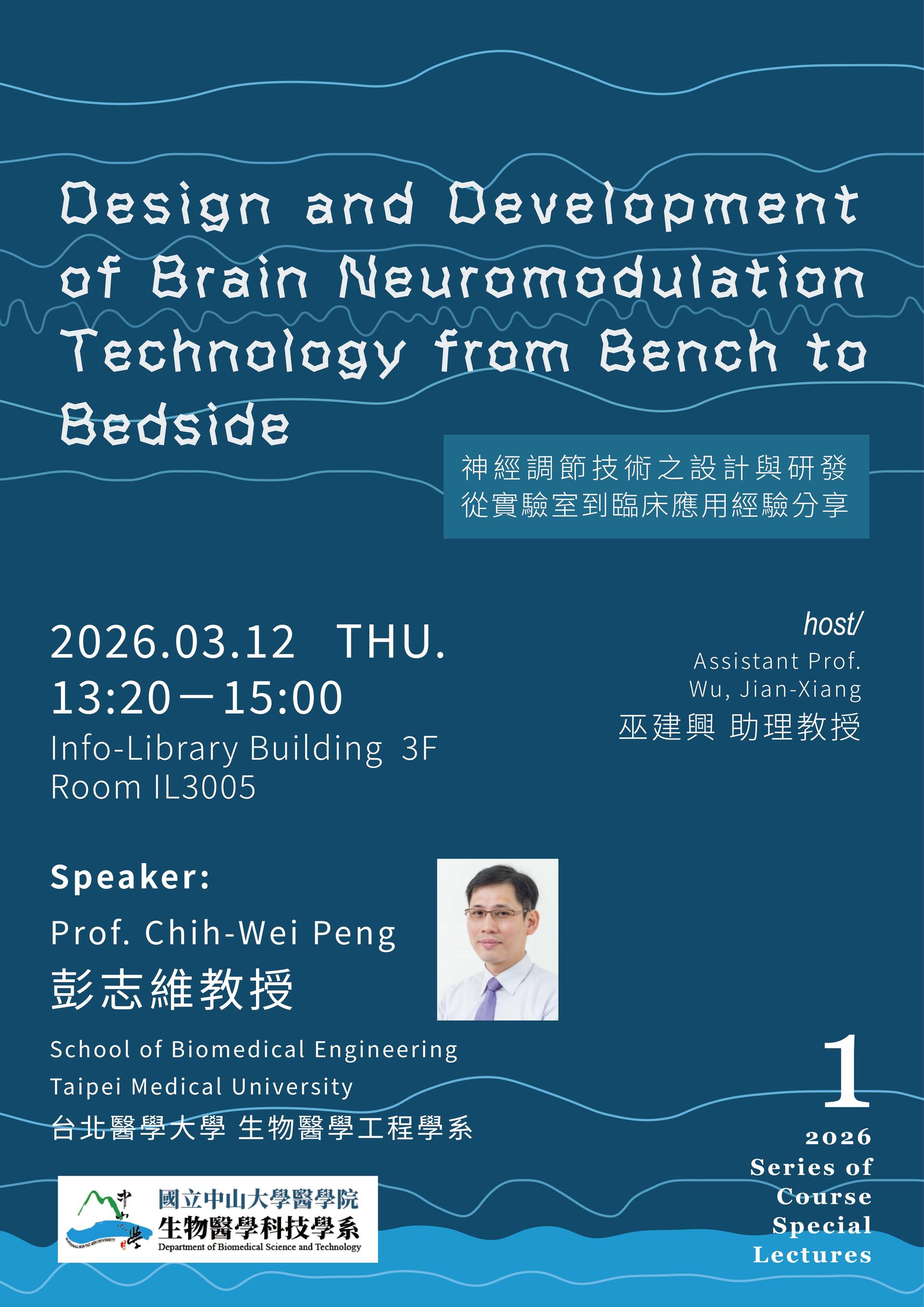
2026年系列課程專題演講 Series of Course Special Lecture
Title|講題
Design and Development of Brain Neuromodulation Technology from Bench to Bedside
神經調節技術之設計與研發:從實驗室到臨床應用經驗分享
Speaker|講者
Prof. Chih-Wei Peng
School of Biomedical Engineering, Taipei Medical University
彭志維 教授|台北醫學大學 生物醫學工程學系
Host|主持人
Assistant Prof. Jian-Xing Wu
Department of Biomedical Science and Technology, NSYSU
巫建興 助理教授|生物醫學科技學系
Date & Time|時間
March 12, 2026 (Thu.) 13:20–15:00
2026年3月12日(四)13:20–15:00
Venue|地點
IL3005
腦神經調控技術(Brain Neuromodulation)為近年神經工程與生物醫學工程領域的重要發展方向。透過電、磁、光或超音波等方式調控神經活動,為帕金森氏症、憂鬱症、慢性疼痛及神經退化性疾病等提供新的治療可能。
本演講將介紹腦神經調控技術的核心原理與發展趨勢,並說明從實驗室研究(Bench)到臨床應用(Bedside)的轉譯醫學流程。內容將涵蓋神經調控裝置設計、超音波與電刺激等非侵入式與微創技術、系統整合與臨床應用案例,以及未來智慧醫療與精準神經治療的發展方向。透過工程、醫學與人工智慧的跨領域整合,腦神經調控有望成為未來神經疾病治療的重要工具。
-
Brain neuromodulation has become an important and rapidly developing field in neural engineering and biomedical engineering. By modulating neural activity through electrical, magnetic, optical, or ultrasound stimulation, neuromodulation technologies provide promising therapeutic approaches for neurological disorders such as Parkinson’s disease, depression, chronic pain, and neurodegenerative diseases.
This lecture will introduce the fundamental principles and emerging trends of brain neuromodulation technologies, and discuss the translational pathway from laboratory research (bench) to clinical practice (bedside). Topics will include the design of neuromodulation devices, non-invasive and minimally invasive techniques such as ultrasound and electrical stimulation, system integration, and representative clinical applications. In addition, the talk will highlight future directions in smart healthcare and precision neuromodulation therapy. Through interdisciplinary integration of engineering, medicine, and artificial intelligence, brain neuromodulation is expected to become a key therapeutic tool for neurological diseases in the future.